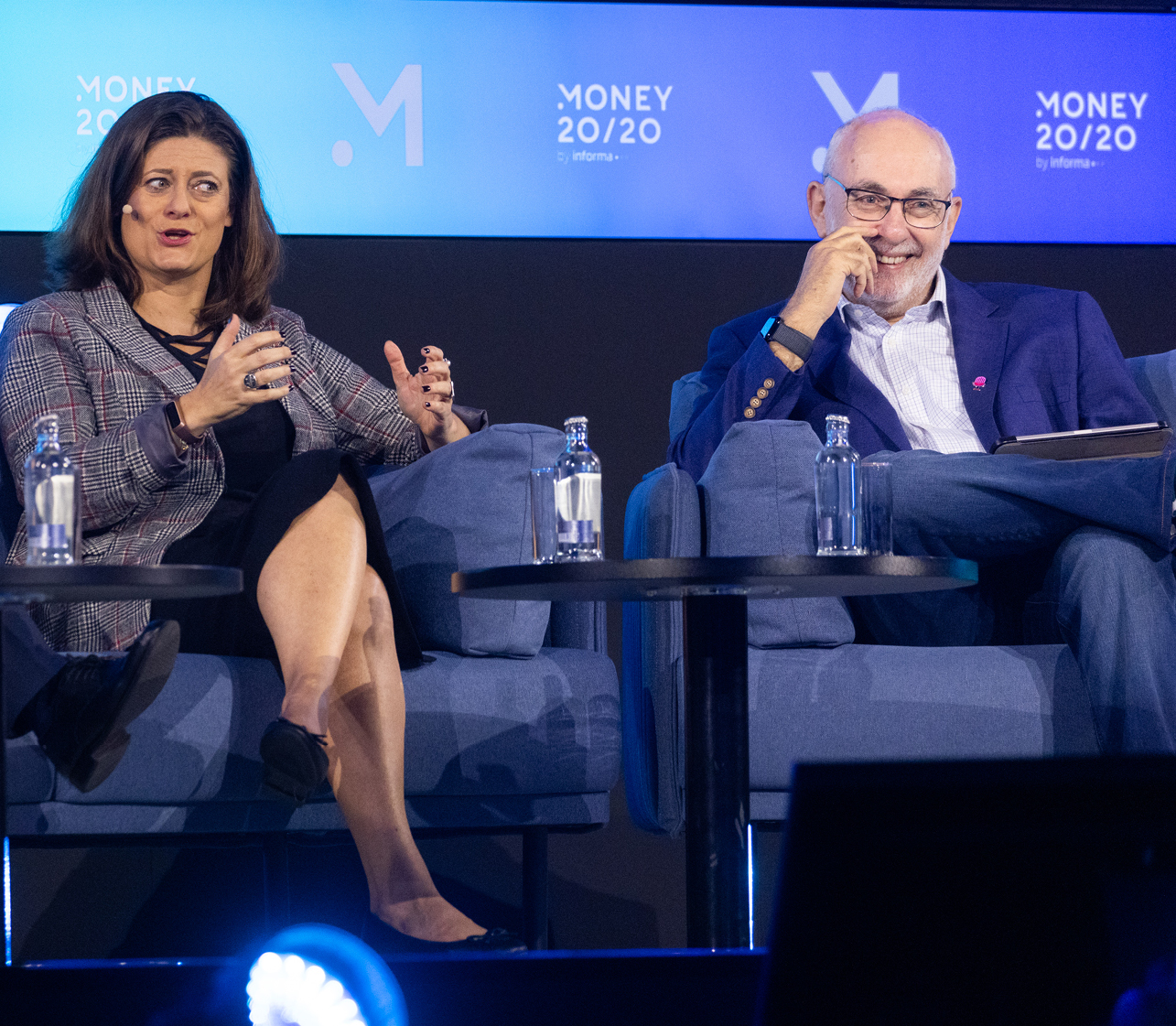
Money20/20 Europe 2026 convened in Amsterdam from 2–4 June, drawing 7,600 attendees from more than 100 countries. I have attended for several years and this was the most navigable edition by some distance, more compact, better designed for conversation and with more space to think. I started running into old friends from the moment Angaj and I walked through the doors!
The central message from the event was that financial services organizations are no longer experimenting with the new technologies; they are rearchitecting how commerce, compliance and customer relationships work. This has direct strategic implications for any business leader, regardless of sector.
Theme 1: stablecoins are now infrastructure
If there was a single word that saturated every corridor, panel and side conversation in Amsterdam this year, it was stablecoins. What is striking is not the volume of discussion but the nature of it: the conversation has shifted decisively from "will this work?" to "how do we build on it?" The steady transition of stablecoins from a marginal payment experiment into fundamental infrastructure for the next generation of financial markets was well underway, and the serious participants know it.
I contributed to this directly, presenting on the Money Lab stage alongside Simon Taylor, with whom I co-authored a paper on the history and future of stablecoins for the Journal of Payment Strategy & Systems. We were joined by Nilixa Devlukia, who helpfully grounded our thinking in practical regulatory reality. The stablecoin conversation has matured to the point where audiences expect genuine insight, not conference theatre, and the response reflected that.
For business leaders outside financial services, the relevant question is how programmable, always-on money will change the economics of their sector. Payments that settle instantly, contracts that execute automatically on fulfilment, and treasury operations that no longer depend on banking hours are near-term operational realities, not distant possibilities.
Theme 2: regulation as competitive advantage
The conference pillar "Regulation in the Fast Lane" reflected something I have observed building steadily across the industry: the organizations moving fastest are not those spending least on compliance, but those that have embedded regulatory capability so deeply it contributes to competitive advantage. The UK's Financial Conduct Authority was cited as a "tech-positive regulator," actively running agent-based use cases in its own AI Lab and testing cross-border frameworks with seventeen international counterparts.
Two forces are converging here. The regulatory burden is growing, not stabilising: the EU's AI Act, MiCA digital asset rules, PSD3, and evolving financial crime frameworks mean compliance complexity is accelerating. At the same time, the firms best placed to enter new markets and launch new products are precisely those that have already built the regulatory infrastructure to do so. The message from Amsterdam was unambiguous: you cannot build first and engage regulators later. The organizations winning are those that treat regulatory readiness as a product feature and build it in parallel.
Theme 3: AI and the trust layer
AI was, predictably, everywhere. I am working with colleagues at Consult Hyperion right now on the specific challenge of bringing safety and security into agentic commerce, so I was less interested in the general hype and more focused on where governance frameworks are forming around the trust layer, specifically the boundary between where an AI agent acts autonomously and where human oversight must intervene.
Adyen's presentation was terrific. Their approach, building verifiable controls into agentic infrastructure rather than bolting them on afterwards, reflects the design philosophy that serious players are converging on. I also participated in a lively debate organized by PPRO on how quickly AI will take over consumer banking interactions. I argued it will happen sooner than most banks think. The audience, pleasingly large for an end-of-day session, found the case harder to dismiss than they expected.
The organizations that will lead are not those with the most AI features, but those that have solved the governance problem, establishing clear, auditable boundaries around what their AI systems can do, on whose behalf, and with what oversight. That is both a technical and a legal challenge, and the two cannot be separated.

Theme 4: fraud, identity, and the eidas moment
I chaired a panel on fraud which drew a strong audience and sharp questions. Fraud remains, in my view, a national emergency that is not being treated as one. It is already the UK's most prevalent crime, vastly under-reported, largely unprosecuted, and growing at roughly 20% year-on-year as AI enables synthetic identities, account impersonation, and coordinated attacks at machine speed. Rules-based detection is ending. Attacks now succeed precisely because they look legitimate at every checkpoint.
The answer is twofold: behavioural intelligence, detecting anomalies in patterns of activity rather than in credentials alone, and robust digital identity. I was fortunate to catch Google's presentation backstage before the panel, which provided a useful cross-reference on the strategic approach we take with global clients.
Fraud is not a payments problem or a banking problem. It is a business problem that touches every sector handling customer data, transactions, or identity. The organizations that will be most resilient are those that move from point-in-time verification to continuous, behavioural trust, and that engage now with the digital identity frameworks being built at national and European level. The infrastructure to make it real is now arriving.
Looking forward
There was a lot going on in Amsterdam, but if I were to try to distill this years’ conversations down to a bumper sticker (!) then I would say that the overarching signal was that the infrastructure of commerce is being rebuilt around intelligence and identity. Stablecoins rewire the plumbing. AI rewires the customer relationship and digital identity is the foundation without which none of it can be trusted. The businesses that act now will set the terms; those that wait will inherit someone else's architecture.

David Birch
Dave Birch is an author, advisor and commentator on digital financial services. He is an international keynote speaker and recognised thought leader in digital identity and digital money. Dave is Global Ambassador for Consult Hyperion, the secure electronic transactions consultancy which he co-founded and which was acquired by Fime in 2025.
Dave is also Principal at 15Mb Ltd., his advisory practice, and holds a number board-level advisory roles with companies in Europe and the USA. He a Senior Research Fellow at King’s Business School in London and a Digital Fellow at the University of Exeter Business School’s DIGIT Lab as well as holding a number of board-level advisory roles with companies in Europe and the USA. Before helping to found Consult Hyperion, he spent several years working as a consultant in Europe, the Far East and North America.
Dave is recognised as an international authority on payments systems, the impact of new technology and the changes that regulators around the world are having to address as consumer choice on payments evolves at an increasing rate.
Once named one of the global top 15 favourite sources of business information (Wired magazine) and one of the top ten most influential voices in banking (Financial Brand), he created one of the top 25 “must read’ financial IT blogs and was found to be one of the top ten Twitter accounts followed by innovators, along with Bill Gates and Richard Branson (PR Daily).
He is a columnist for Financial World magazine and has written for publications ranging from the Parliamentary IT Review to The Financial Times. He also wrote a column in The Guardian for many years. A media commentator on electronic business issues, he has appeared on BBC television and radio, Sky and other channels around the world.
Launched at Money20/20 Asia in April 2024, Money in the Metaverse, co-authored with Victoria Richardson, explores how metaverse builders and financial services strategists can collaborate to unlock value from virtual worlds through digital assets and digital identity.
His previous book, The Currency Cold War, examined the geopolitical and economic stakes of digital currencies, both private and central bank, arguing that coherent national and corporate strategies are now imperative.
Before that, Before Babylon, Beyond Bitcoin, published with a foreword by Andrew Haldane, traced the evolution of money from ancient systems to intelligent digital currencies and was praised by London School of Economics Review of Books as a timely and illuminating contribution for scholars and policymakers alike.
His 2014 work, Identity is the New Money, described by the London Review of Books as fresh, original and wide-ranging, set out the provocative thesis that in the digital age identity, not cash, will underpin the future of transactions and economic trust.