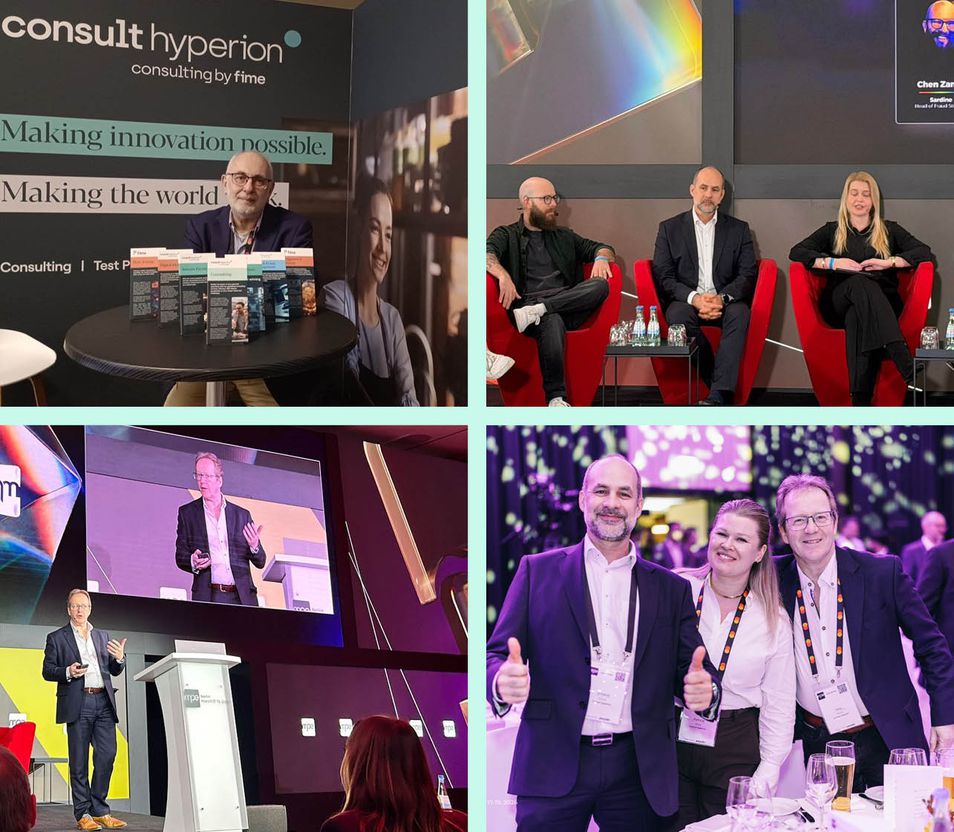
MPE 2026 recently took place in Berlin, bigger than ever, with a packed program. Consult Hyperion, consulting by Fime, has a long relationship with MPE. Dave Birch has chaired the event for many years, while Arnaud Crouzet and myself have hosted panel sessions and round tables, and been part of the prestigious MPE Awards panel of judges. We put a lot of effort into MPE, and we get a lot out of it. It is without doubt my favorite payments event of the year.
Leadership and opening panels.
This year, Ruth Wandhofer was chair of MPE, and did an excellent job, particularly with the first panel session which set out the scene for this year’s conference. The discussion addressed the role of AI, cross-border payments, the rise of stablecoins, and the progress and impact of a digital euro. The first panel set the scene to prepare for future commerce.
Later that day, Dave Birch took part in an interesting panel session looking at Stablecoins: Quietly going live. With Eric Tak on the panel, perhaps it should have been called Digital currencies going live. The discussion focused on the issues digital currencies are solving for today, how they fit with the modern payments ecosystem and where they will lead to tomorrow, particularly with AI / Agentic.
It is gratifying that many of these MPE key themes of Agentic Commerce, Resilience, Digital Currencies and Post Quantum are themes that Consult Hyperion are already helping our clients with.
Agentic commerce: real-world insights.
What is great about MPE is the quality of content, with no marketing presentations and genuine industry insight. Particularly in the context of agentic commerce, where the conversation was not about the hype, but covered real-world use cases and raised critical concerns. This included multiple competing standards, the lack of trust and liability framework concerns. Agentic commerce is taking steps forward, with human in the loop, but as we look forward to human out of the loop the issue to resolve increases, including how to capture the initial user intent, which is rising to the fore.
Pragmatic innovation in payments.
Arnaud Crouzet took part in a panel focusing on pragmatic innovation, moderated by Vendorcom’s Paul Rodgers. Looking at how to modernize tech stacks, bringing both efficiency and resilience to an organization’s payments system. Finding the right balance between legacy and emerging technologies, and what strategy to adopt in order to build effective payment infrastructure, a question that is critical to so many of our clients who are updating and adapting their payment stacks.
At the same time Arnaud was on his panel, I moderated a panel on the Next generation of tokens. Patricia Ferrer from Mastercard and Ali Jaffal from Worldline set the scene with keynotes on what Mastercard and Worldline were doing to accelerate tokenization, and some of the key issues. Patricia and Ali were then joined on the panel by Jack Mangnall from Shape and Daniel Foster from Adobe.
The panel set the scene on tokenization today, the rise of digital wallets and the move towards network tokenization for transactions across the payment networks. Challenges remain, particularly in relation to Least Cost Routing, where acquirers must work with both PANs and tokens to enable favorable routing, there has to be a better way. Mastercard’s goal of removing PANs from e-commerce by 2030 led to an interesting discussion on fraud, the role of tokens, Click to Pay, and other digital wallets, all aimed at removing the need for customers to enter PANs and the benefits that would bring.
The role of tokenization in agentic commerce is seen as critical, as we have to ensure that only good actors, carrying out valid instructions, are initiating transactions. There is much work to be done here, but the groundwork is in place. There is a lot to learn in tokenization and the panel provided the audience with valuable insights and practical guidance.

Quantum-ready infrastructure.
MPE somehow combines a busy schedule with plenty of time for networking and discussion with colleagues old and new. The final panel of the conference, before Ruth took to the stage for the conference outcomes discussions, again involved Dave Birch, this time looking at Future-proofing payments with quantum ready infrastructure. Moderated by Julia Streets (who also hosted the MPE Awards alongside the awards chair Neira Jones) and joined by Rebecca Krauthamer of QuSecure and Hanna Engel a Microsoft MVP and Quantum Circle Representative. The session covered everything quantum, from understanding (well almost) what quantum is, the threats it may pose to payment security, and some practical advice on what to do, doing nothing is not a sensible policy.
Looking ahead.
Another insightful and fascinating three days in Berlin at MPE have come to a close. Next year marks the 20th year of Empiria Events organizing these conferences, and they really do it well, so the 20th anniversary should be special, look forward to seeing you all there.

Gary Munro, Vice President Payments Consulting
Gary joined Consult Hyperion in 2011, following his role at Gemalto where he led the Point of Sale (POS) Division in the UK and the Republic of Ireland, prior to and during its acquisition by VeriFone. He brings over 35 years of experience in secure electronic payments, with a strong track record in designing and delivering point-of-sale solutions tailored to the needs of some of the world's largest acquirers and payments processors.
Following Fime’s acquisition of Consult Hyperion, Gary is now part of Fime’s unified Consulting team, which continues to operate under Consult Hyperion brand to reflect its strong market reputation.
Gary leads retail transaction consulting activities, advising payment networks, retail banks, acquirers, merchants and fintechs on the technical, security, hardware and software aspects of their payment solutions. He has supported several central banks in the design of CBDC payment systems and helps payment networks define their functional and security requirements for payment services. He also provides strategic guidance during vendor selection processes, and conducts Technical Due Diligences assessments for investors and organizations to evaluate the robustness and effectiveness of critical business infrastructure.